The world’s longest undefended border has always carried more than goods, commuters, and vacation traffic. It has carried habit. For generations, Canadians treated a weekend in Buffalo, a March break in Florida, a shopping run to Maine, or a summer drive through Washington State as familiar and almost automatic.
That habit has been broken. Canadian travel to the United States fell sharply through 2025 and remained weak into 2026, even as Canadians continued travelling elsewhere. The shift is now large enough to show up in government data, airline planning, tourism reports, border-state complaints, and congressional analysis. What began as scattered frustration over politics, prices, border anxiety, and U.S.-Canada tensions has become a measurable economic story — and Washington is beginning to understand that Canadian visitors cannot be taken for granted.
The Pullback Is No Longer Anecdotal
The first mistake is treating the Canadian travel slowdown as a social-media mood swing. It is now visible in official data. Statistics Canada reported that Canadian-resident return trips from the United States totalled 29.1 million in 2025, down 25.4 percent from 2024. That is not a mild softening. It represents a major change in one of the most routine cross-border behaviours in North America.
The striking part is that Canadians did not simply stop travelling. In the same year, Canadian-resident trips to overseas countries rose 9.2 percent to 14.2 million. That contrast matters. It suggests the United States was not just losing trips to inflation or general household caution. Canadians were still spending on travel, but more of that spending was going to Europe, Mexico, Asia, domestic destinations, and other alternatives instead of traditional U.S. routes.
The Land Border Is Feeling It First
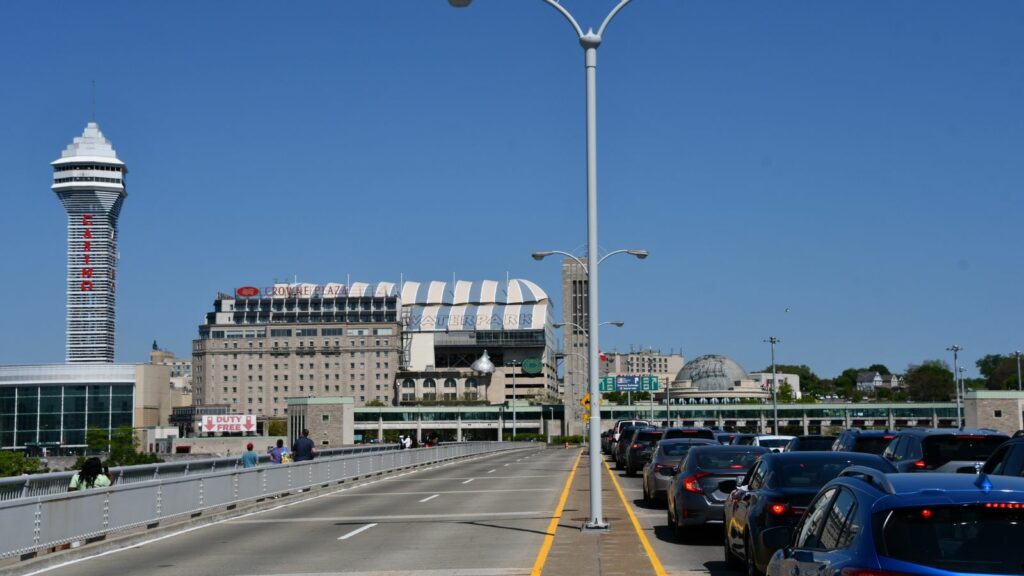
The clearest sign of the slowdown has been at the land border. Same-day and short overnight trips are often the easiest to cancel because they do not require months of planning. A family that once drove from southern Ontario to upstate New York for shopping can redirect that money locally. A couple in British Columbia can skip a Washington State weekend without dealing with airline penalties or resort deposits.
U.S. transportation data shows the scale. Personal vehicle crossings from Canada into the United States fell 18.8 percent in 2025, dropping from 22.6 million in 2024 to 18.3 million. The Blaine crossing in Washington State saw one of the steepest drops, down roughly 25 percent. Statistics Canada also found severe early declines in automobile return trips from the U.S. in 2025, including a 38.1 percent year-over-year fall in May. That is the kind of decline that shows up quickly in gas stations, outlet malls, border-town diners, duty-free shops, and hotels.
Air Travel Shows a More Deliberate Shift
Air travel tells a slightly different story because it usually reflects bigger decisions: family vacations, Disney trips, conferences, snowbird travel, cruises, and longer holidays. Those trips are harder to replace overnight, yet Canadian air travel to the United States also weakened. Statistics Canada reported that Canadian-resident return trips from the U.S. by air fell 24.2 percent year over year in May 2025 and continued to show pressure into 2026.
The travel industry has seen that hesitation in bookings. Reuters reported that foreign travel to the United States was down 5.4 percent through November 2025, led by 4 million fewer visits from Canadian travellers, a 22 percent decline from the previous year. The same report described Canadians shifting Disney-related vacations away from U.S. parks and toward alternatives such as Disneyland Paris and Disney cruises abroad. That kind of substitution is important because it shows the U.S. is losing not only bargain shopping trips, but emotional, high-value vacation spending.
The April Rebound Comes With a Big Asterisk
There was one encouraging headline for the U.S. travel industry in spring 2026: Canadian-resident return trips from the United States rose 1.4 percent year over year in April. On paper, that marked the first year-over-year increase since December 2024. For anyone looking for signs of recovery, it was the first real opening after more than a year of declines.
But Statistics Canada warned that the increase was partly a base-year effect. Compared with April 2024, Canadian-resident return trips from the United States were still down 30 percent. Automobile trips were down 31.4 percent and air trips were down 26.4 percent from that two-year comparison point. In other words, the rebound looked better only because April 2025 had already been so weak. The deeper trend still shows a U.S. travel market that has not returned to its old Canadian rhythm.
Canadians Are Still Travelling — Just Not South as Often
A key reason this story has become so important is that Canadians remain active travellers. In the second quarter of 2025, Canadian residents took 90.6 million domestic trips, up 10.9 percent from the same quarter in 2024. Domestic tourism spending reached $20.3 billion, up 13.5 percent. That is a strong signal that many households were still making room for travel, even while reconsidering U.S. plans.
Outbound patterns moved in the same direction. During that same quarter, Canadians took 5.6 million trips that included a visit to the United States, down 21.6 percent year over year. Meanwhile, trips to overseas countries rose 10.4 percent, and overseas spending climbed 28.4 percent. Mexico, France, and the United Kingdom ranked among the most visited overseas destinations, while Japan, Spain, and France saw some of the largest increases. The message is simple: the U.S. is no longer the automatic default.
Politics Has Become Part of the Travel Budget
Travel decisions are often explained through price, weather, and convenience. This shift includes all three, but politics has become unusually central. Flight Centre Canada, citing a YouGov survey, found that 62 percent of Canadians said they were less likely to visit U.S. destinations in 2026 than the previous year. The top reasons included political or cultural climate, border hassles or restrictions, safety and security concerns, exchange rates, and overall cost.
Longwoods International found a similar pattern. Its January 2026 survey reported that 59 percent of Canadian travellers said U.S. government policies, trade practices, and political statements made them less likely to travel to the United States in the next 12 months. Among those influenced by U.S. politics and policy, 73 percent pointed to tariffs and statements by U.S. political leaders as the main negative factors. That is why the travel slowdown cannot be understood as just a weak-dollar story.
Border States Are Counting the Missing Weekenders
The impact is not spread evenly across the United States. Border states feel it first because they rely heavily on short Canadian visits. New York, Washington, Michigan, Maine, Vermont, Minnesota, and New Hampshire all have local economies where Canadian plates in parking lots are part of normal business. When those visitors disappear, the effect is visible in restaurant receipts, hotel occupancy, ferry bookings, campgrounds, ski hills, and retail traffic.
A U.S. Joint Economic Committee minority report found that passenger vehicles crossing the U.S.-Canada border fell nearly 20 percent from January to October 2025 compared with the same period in 2024, with some states seeing declines as large as 27 percent. The report included examples from multiple border states, including fewer Canadian campground reservations in New Hampshire, reduced Canadian crossings into New York, and lower Canadian traffic in Washington. These are not abstract numbers for local businesses. They are missing customers.
The Spending Gap Has Washington’s Attention
Canada has long been the most important international visitor market for the United States. The U.S. Travel Association said Canada was the top source of international visitors in 2024, with 20.4 million visits generating $20.5 billion in spending and supporting 140,000 American jobs. The association warned that even a 10 percent reduction in Canadian travel could mean 2 million fewer visits, $2.1 billion in lost spending, and 14,000 job losses.
That is why Washington is starting to notice. The issue is no longer just a Canadian consumer protest or a tourism-board headache. It is a U.S. export problem. Travel spending by foreign visitors functions like an export because money flows into American hotels, restaurants, attractions, retailers, and transportation businesses. When Canadians choose Jasper, Lisbon, Cancun, Tokyo, or Paris instead of Florida, Nevada, New York, or Washington State, the economic loss lands on the U.S. side.
Travel Friction Is Now Part of the Calculation
For most Canadian citizens, U.S. travel remains legally accessible. Canadians generally do not need visitor visas for ordinary trips, and the border is still one of the most active in the world. But the perception of friction has changed. Government of Canada travel guidance notes that U.S. border agents can search electronic devices when travellers enter the country, and refusal may lead to delays, device seizure, or denial of entry for non-U.S. citizens.
Even when most travellers pass through without incident, perception matters. A trip that once felt easy can start to feel uncertain if headlines focus on border searches, immigration enforcement, visa changes, political hostility, or social-media screening proposals. For casual leisure travellers, the bar is simple: if another destination feels warmer, easier, or less emotionally charged, the U.S. has to work harder to win that booking back.
The Hardest Thing to Restore May Be Trust
The U.S. tourism industry can discount hotel rooms, add flight deals, launch ad campaigns, and court Canadian travel agents. Those moves may help at the margins. But the bigger challenge is rebuilding trust and comfort. Canadians have not stopped liking American cities, beaches, sports, theme parks, shopping, or national parks. The problem is that the emotional calculation around visiting has changed.
That is why the decline could last longer than a normal travel-cycle dip. A weak exchange rate can improve. Airfares can fall. Political tensions can cool. But once families build new habits — March break in Mexico, summer in Atlantic Canada, Disney in Europe, ski trips at home, shopping online instead of across the border — some of that spending may not automatically return. Washington is noticing because the old assumption was that Canadians would always come back. The data now says that assumption is no longer safe.
